
Review: The School for the Contemporary Arts' Emergence 2026
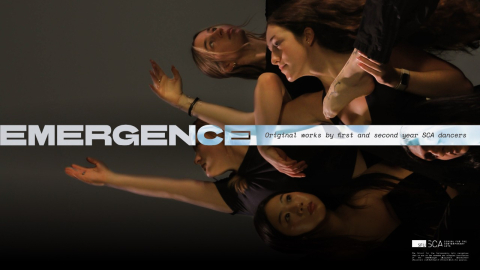
For several years running, the School for the Contemporary Arts at SFU has been uplifting its dance students through an annual performance, choreographed and conducted solely by its students. 2026’s Emergence saw nineteen original compositions from first and second year dance students, reaching across multiple dance genres and disciplines into one seamless performance. CJSF sat down with the two organizers of this year’s production, Lucy Price and Jennifer Yang, to discuss the behind-the-scenes of Emergence.
CJSF: I'm wondering what the process looks like behind the choreography for interpretive pieces like this. Some of them were very story-based and kind of narrative-based, and I'm wondering if some of these pieces start with a story or a theme, or if they develop more from the song and the beat behind it? What's the process like?
Jennifer: Everything's really based on the choreographers, so everyone has a kind of different process. Since everything is student-led, the choreographers have the say and how they work and how they approach their pieces.
Lucy: Yeah, and I know some people chose concepts that were, I don't know, something like Greek mythology or some people chose more personal stories. I know there are some improv pieces as well. So some of them weren't even choreographed. They just kind of went out there and improvised to the music and the beats.
CJSF: And then just bouncing off of that, across all nineteen performances, there were such an array of genres and artists that people put movement to. Like, it was all the way from Bob Dylan to Doechii, and it was just really cool to see. What are some things that you guys look for in a song when you're looking to choreograph it?
Lucy: For me, I feel like I like music that has a lot of different noises in it. Like whether it's an EDM song, something that has a lot of layers [ . . . ] things that have interesting sounds in it, so that when you're dancing, you can kind of pick up these like little beats and you can be dancing to like multiple different textures.
Jennifer: Yeah, similarly, I like choreographing to songs that I like listening to. So that's very intuitive. If I like listening to it, I'll like dancing to it most of the time.
CJSF: So you guys both organized the production itself, which is a huge feat given the number of dance students in the production, with nineteen original works that you all had to give equal time to. And you guys performed in multiple works as well. So what was the most challenging part of bringing this production together?
Jennifer: Honestly, I think it was the smoothest it could ever have gotten. We had a lot of support from our faculty and staff here at SFU. And of course, all the choreographers were very on it with finishing their pieces in time for the show barely. But we made it.
Lucy: And we, the team that we had as well was super amazing. Like from the production and design cohort and the film cohort, everyone was very, very helpful. So yeah, it was really nice working with the other majors as well.
CJSF: How have the recent budget cuts to various arts programs at SFU shaped your understanding of how important the arts are within SFU?
Lucy: Well, I mean, if the more of a budget any of these shows have, the more, I guess, resources we can put into it. But even with the budget that we were given, it was still very doable just because of the studio booking spaces that the students have in the [School of the Contemporary Arts]. We were able to use the studio and stuff, and not really have to pay for that. But if we wanted to use any of the other studios or anything, it would be more challenging. But yeah, it's definitely very important, where obviously we love what we do. And it would be nice to have more, but we are also very happy with what we have as well.
CJSF: Then just to bounce off of that, both nights were sold out events. So, congratulations on that, both sold out. How can students and faculty and audiences better support dance programs, especially at SFU?
Lucy: I mean, for the other majors in the SCA specifically, because we all have chances to work together throughout our degree, it's nice when people in our building also come and support us just because then it makes it easy to collaborate. Usually, the art communities are kind of small.
Jennifer: I think, for people outside of the dance world, or from just beyond – I don't want to say just be aware– but if you're in the dance world or you know shows are coming up, share it with your friends to get them to come. It’s like any other event, like a movie, but you’re seeing real performers doing what they’re passionate about.
CJSF: And I've just got one quick last question before I let you guys go. I was curious about where the name Emergence came from for the production itself.
Jennifer: So previously it was called something else. I can't think of the name right now. But Emergence was developed last year by the runner, the showrunners last year, as something that will be continuously used for clarity purposes.
Lucy: We have a show for like the third and fourth years called Ascension [ . . .] think Emergence is like the first one you do as a first and second year student. And then the second one is Ascension, because you're getting higher into the program.
CJSF: Okay, so this is, it's meant to be kind of a legacy to carry on for some of the dance students, the name itself is being passed down, I like that. Thank you very much for your time guys, I really appreciate you coming on.
Lucy: Thank you.
Jennifer: Yeah, thank you.